 Ages 3–5 years
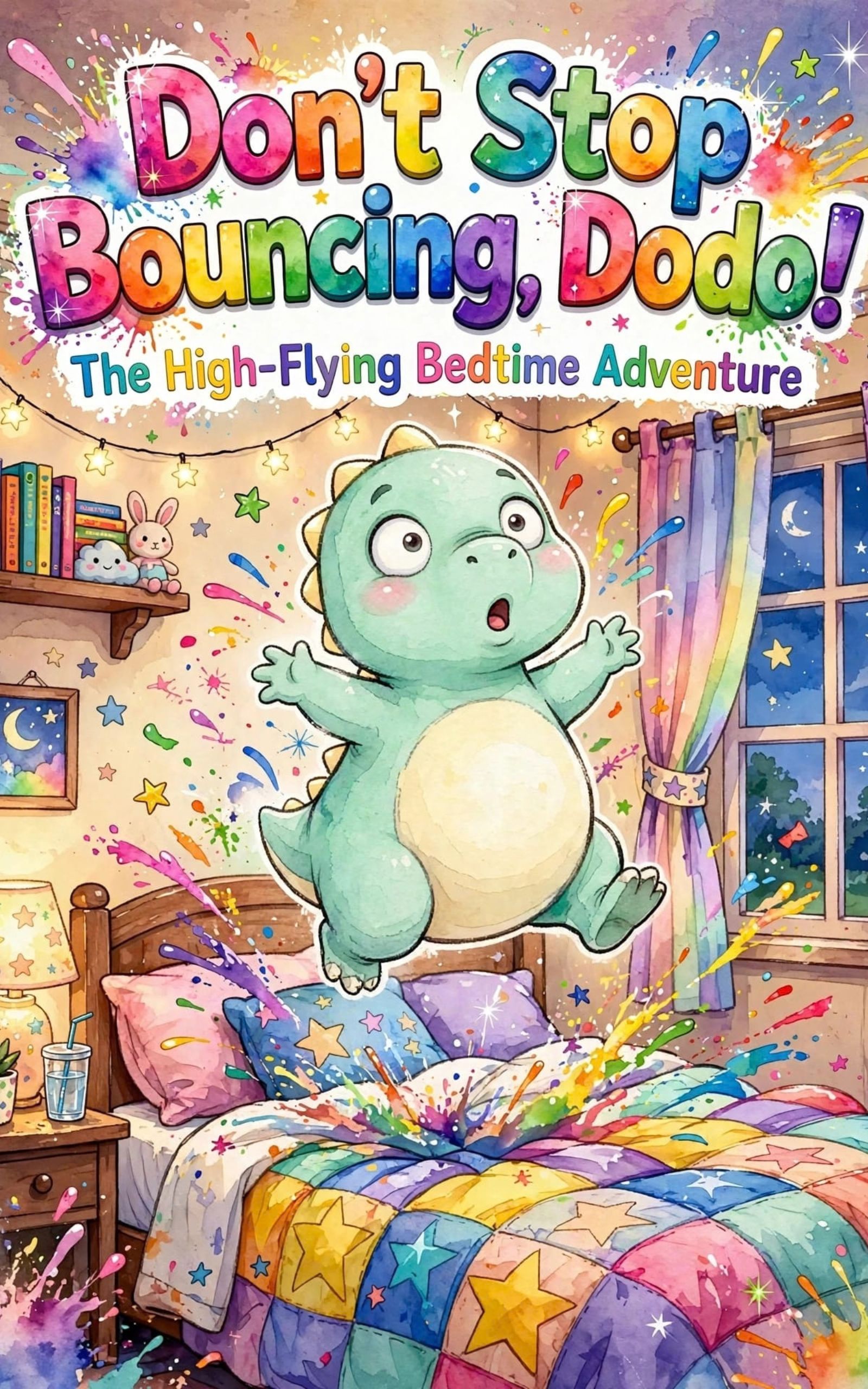
Don't Stop Bouncing, Dodo!: The High-Flying Bedtime Adventure
BOING!
Explore This Story Join Story Club
Reading Together
It's 9:04 p.m. Your child has been bouncing on the bed for twenty minutes. You've asked for calm, you've read the story twice, and somehow the story made it worse — now they're acting out every page. You're exhausted, they're wide awake, and tomorrow morning is coming for both of you.
The bouncing is not the problem. It is the last of the day's energy looking for somewhere to go — and starting with "lie still" asks a body full of wiggles to do the hardest thing first.
Give the wiggles a job before you ask for calm. Spend 2 minutes bouncing on purpose — a counting bounce game, before bath time — then dim everything down together: lights lower, voice softer, pace slower. Finish with one short, breathe-with-me story. Skip screens and brand-new games in the last 10 minutes; both wake the brain back up.
Two things collide at bedtime, and both push in the same direction.
First, overtired looks like over-energetic. When a young child passes their sleep window, their body doesn't quietly power down — it rallies. It looks like they have too much energy. What it usually means is they needed sleep ten minutes ago, and their body is compensating.
Second, the day's energy is unfinished. Most small children spend the day sitting more than their bodies expect — in a car seat, at a table, waiting for a grown-up to finish something. By evening, the movement they never got is still there, waiting.
Neither is misbehaviour — your child's body is doing what bodies do when tired and still full of movement. Once you see it that way, the routine becomes a sequence: spend the energy, then slow down.
This is the step that feels wrong and works anyway. Before bath — not in bed, not in pyjamas — give bouncing a proper job.
Try a counting bounce game: "Let's bounce to ten, then land like a feather." Count out loud together, bounce on the spot or on a cushion on the floor, and on ten, flop down soft and still for three slow breaths. Do it twice if the first round ends in giggles. Two minutes is enough — you're letting the biggest wiggles out on purpose, while bouncing is still allowed.
Two rules keep it working:
If your child asks for "one more round," that's a good sign. Smile, say "tomorrow night, same game," and move to bath.
After bath, turn all three dials down together — children read the whole room, not just your words:
Do the three together, in the same order, every night. Within a week or two, the sequence starts doing the work on its own.
The last story should land the plane, not take it off again. Pick one short, familiar story — the same one, night after night — and read it the same slow way each time. A story they already know asks nothing new of their brain, so it can finally rest.
The best landing-strip stories breathe with the reader: the characters slow down and settle as the pages turn, so your child practises calm by following along. Read the last page at half speed, pause before closing the book, then one quiet line: "Sleep time now. I'll be right outside."
Before bath, play the 2-minute counting bounce game — bounce to ten, land like a feather, three slow breaths, twice. Then lights down, voice down, pace down, and finish with the same slow story as last night. Don't explain it. Just run it, in the same order.
Two things reliably undo the dim-down, even on a good night:
If screens or a new game already happened tonight, just start the dim-down where you are. Routines are built over weeks, not won in a single night.
Children learn routines through stories they love enough to revisit:
In Don't Stop Bouncing, Dodo!, Dodo bounces higher and higher — then, page by page, comes back down to dreamland. Reading it after the bounce game turns it into a mirror: your child has just done what Dodo does, and now lands with him. Ages 3–5.
Find it here: Don't Stop Bouncing, Dodo! (all book links on this site go through our book pages to Amazon).
Sparkle's Bedtime Hug is the other half: a breathe-with-me story where Sparkle the fox and Cloudy share a quiet forest moment until the forest sleeps — the story to reach for once the bouncing is done. Ages 3–8.
Find it here: Sparkle's Bedtime Hug (all book links on this site go through our book pages to Amazon).
More stories for the same routine: if your child loves a story that joins in, try Milo and the Starry Body Scan (ages 3–7), where Milo's busy thoughts settle with a bedtime body scan; Don't Pop the Bubbles in This Book! (ages 3–8), a bath-time bubble adventure for the energy-spending part of the evening; Don't Shout at This Book! (ages 3–8), which moves from noisy play to quieter moments, just like the dim-down; and Don't Shine a Light in This Dark Room! (ages 3–8), a flashlight-and-shadow adventure for a dark room. Pick one — the routine works best with a single familiar story, not four new ones in one night.
Shorten it, don't drop it. One round instead of two, count to five instead of ten, and land like a feather with three slow breaths before the giggles peak. If bouncing on the bed is the problem, move the game to a cushion on the floor and keep beds for the slow part of the evening only. Most children settle into the game within three or four nights, once they learn that bouncing always ends the same way — softly.
Give it a full week of the same order, same time, before you judge it. The first two or three nights often look unchanged — your child is learning the sequence, not yet trusting it. By the end of the week, watch for the small signs: they start heading for the cushion when bath time approaches, or they remind you it's bounce time. That's the routine taking hold. It won't make every night easy, but it makes the hard nights shorter.
Run the short version: skip the bounce game, keep the dim-down and the one landing story. A tired parent doing two steps in the same order beats a perfect routine done once and abandoned. On the hardest nights, the routine is allowed to be three minutes long — lights down, one slow story, "sleep time now." The sequence matters more than the length.
Keep going: For more on big feelings at storytime, read How to Create a Calm Corner at Home for Toddlers and Preschoolers — or browse the Storytime Journal for more. Coming Nov 11: "\"Don't Touch My Tower!\" How to Turn Cleaning Up Toys Into a Game."
Free to try: Print the My Feelings Weather worksheet from our Free Resources page and try it at tonight's storytime.
Stay in the loop: Join the Story Club for one gentle story idea each week.
Ages 3–5 yearsBOING!
Explore This Story Ages 3–8 years
At bedtime, Sparkle the fox and Cloudy share a quiet forest moment.
Explore This Story Ages 3–7 years
Milo the monkey feels tired after a busy day, but his thoughts are still busy.
Explore This Story Ages 3–8 years
Dodo’s bubble adventure uses playful tactile-style prompts and a bath-time theme.
Explore This Story Ages 3–8 years
Voices become part of Dodo’s interactive reading world.
Explore This Story Ages 3–8 years
Dodo’s flashlight-and-shadow adventure uses pretend light interactions.
Explore This StoryUse a weather drawing as an optional way to talk about a feeling.
Ages 4–8
Printable HTML • opens in your browser • personal and classroom use