 Ages 3–5 years
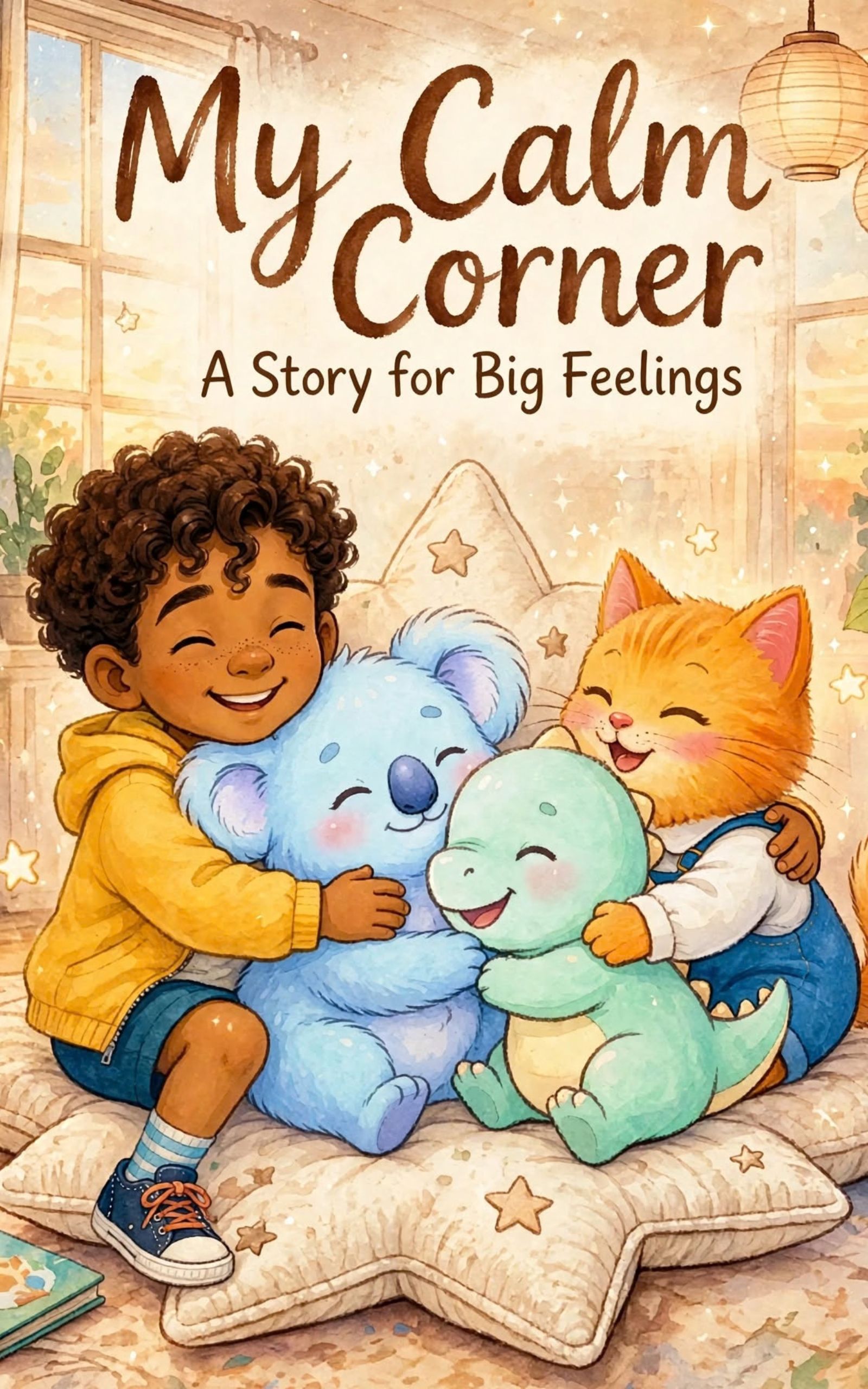
My Calm Corner: A Story for Big Feelings
Big feelings are not bad behavior — they are messages.
Explore This Story Join Story Club
Mindfulness / Big Feelings
It's 5:47 p.m. Dinner is half-made, the baby is crying, and your three-year-old has just thrown himself on the kitchen floor because you cut his toast the wrong way. You've tried time-out. It ends with both of you in tears, and nothing changes the next day.
Here's what many parents are discovering: the problem isn't that your child needs a bigger consequence. It's that big feelings need somewhere to go. A calm corner gives those feelings a place to land — and it takes about one evening to set up.
A calm corner is a small, cozy spot where your child can go — or be gently invited — to cool down big feelings. It is never a punishment. Stock it with six simple things: a soft cushion, feelings cards, a calm-down book, a sensory bottle, a cuddly toy, and a breathing card. Put it somewhere quiet but visible, and introduce it when everyone is calm, not mid-meltdown.
A calm corner is your child's reset button, not your discipline tool. The difference matters more than anything else in this article.
Time-out says: you did something wrong, go away until you're good again. A calm corner says: your feelings are too big right now, and here's a safe place to let them get smaller. One pushes the child away from you; the other gives them a path back to calm — and back to you.
That is why the number-one rule is: never send a child to the calm corner as a punishment. The moment it becomes "go to the corner," it becomes time-out with cushions, and your child will avoid it exactly when they need it most. The corner works only if your child experiences it as a good place — somewhere they choose, or are warmly invited, to go.
You don't need to buy anything fancy. The best calm corners are built from things already in the house:
That's it. If it doesn't fit in a laundry basket, it's too much.
Pick a spot that is quiet but not isolated: the corner of the living room, a nook in the hallway, beside your reading chair. Your child should feel tucked away, not banished. Avoid bedrooms if you can — you want the corner associated with calming down, not with being sent away.
How small? Smaller than you think. A 3-by-3-foot square is plenty. Some families use a pop-up tent; some just lay a special blanket in a corner. The smallness is a feature: it makes the space feel like a hug.
One more placement tip: keep it visible and available all the time, not something you assemble mid-crisis. A calm corner that only appears when someone is already screaming reads as a punishment, no matter what you call it.
This is the step most parents skip — and it's the one that decides whether the corner works. Never introduce the calm corner during a meltdown. Build it together on a calm Saturday morning, sit in it together, read the book there, shake the glitter bottle for fun. Let your child name it ("the cozy spot," "the cloud corner" — their name, not yours).
Then, when big feelings arrive, invite — don't order:
If they say no, that's fine — the invitation itself teaches them the corner exists. Many children start using it on their own within a week or two, often dragging their cuddly toy over without a word. That's the win.
Children learn emotional skills the way they learn everything else — through stories they love enough to revisit. In My Calm Corner – Feelings Mindful, Mochi, Miles, Mimi, and Dodo build a cozy calm corner together: one cushion, one quiet book, and one deep breath at a time. Reading it in your new corner turns the book into part of the ritual — and gives your child familiar friends who already know what to do when feelings get big.
Find it here: My Calm Corner – Feelings Mindful (all book links on this site go through our book pages to Amazon).
After dinner, when everyone is calm, build the corner together in 15 minutes — cushion, blanket, one stuffed animal, and the free My Feelings Weather printable from our Free Resources page. Sit in it together and read one short book. Don't explain the rules. Just let it become the nicest square meter in your house.
Don't force it — a forced calm corner is just time-out. Keep inviting warmly ("I'll be in the cozy spot if you want to join me") and use it yourself sometimes: sit down, take three slow breaths, and let them see you do it. Children copy what works for the grown-ups they trust. Most start visiting on their own within a couple of weeks.
Time-out removes the child as a consequence for behavior; a calm corner offers the child a tool for feelings. In time-out, the child is alone with the instruction to "think about what you did." In a calm corner, the child is never sent — they go or are invited — and the focus is on the feeling getting smaller, not on the behavior being punished. You can also stay with them, which you can't do in a time-out.
It works best from around 18 months to 6 years, but the idea scales: older children often prefer a "calm spot" with a sketchbook or headphones instead of a glitter bottle. Toddlers will mostly co-regulate — meaning they'll calm down with you in the corner, not alone in it — and that's exactly how it's supposed to work at that age.
Keep going: For more on big feelings at storytime, read How to make room for big feelings during storytime — or browse the Storytime Journal for more. Coming Nov 4: "Why Won't My Child Wind Down at Bedtime?"
Free to try: Print the My Feelings Weather worksheet from our Free Resources page and try it in your new corner tonight.
Stay in the loop: Join the Story Club for one gentle story idea each week.
Ages 3–5 yearsBig feelings are not bad behavior — they are messages.
Explore This StoryUse a weather drawing as an optional way to talk about a feeling.
Ages 4–8
Printable HTML • opens in your browser • personal and classroom use