 Ages 3–7 years
Honest Mimi
Mimi faces a choice about admitting a mistake.
Explore This Story Join Story Club
Kindness & Boundaries
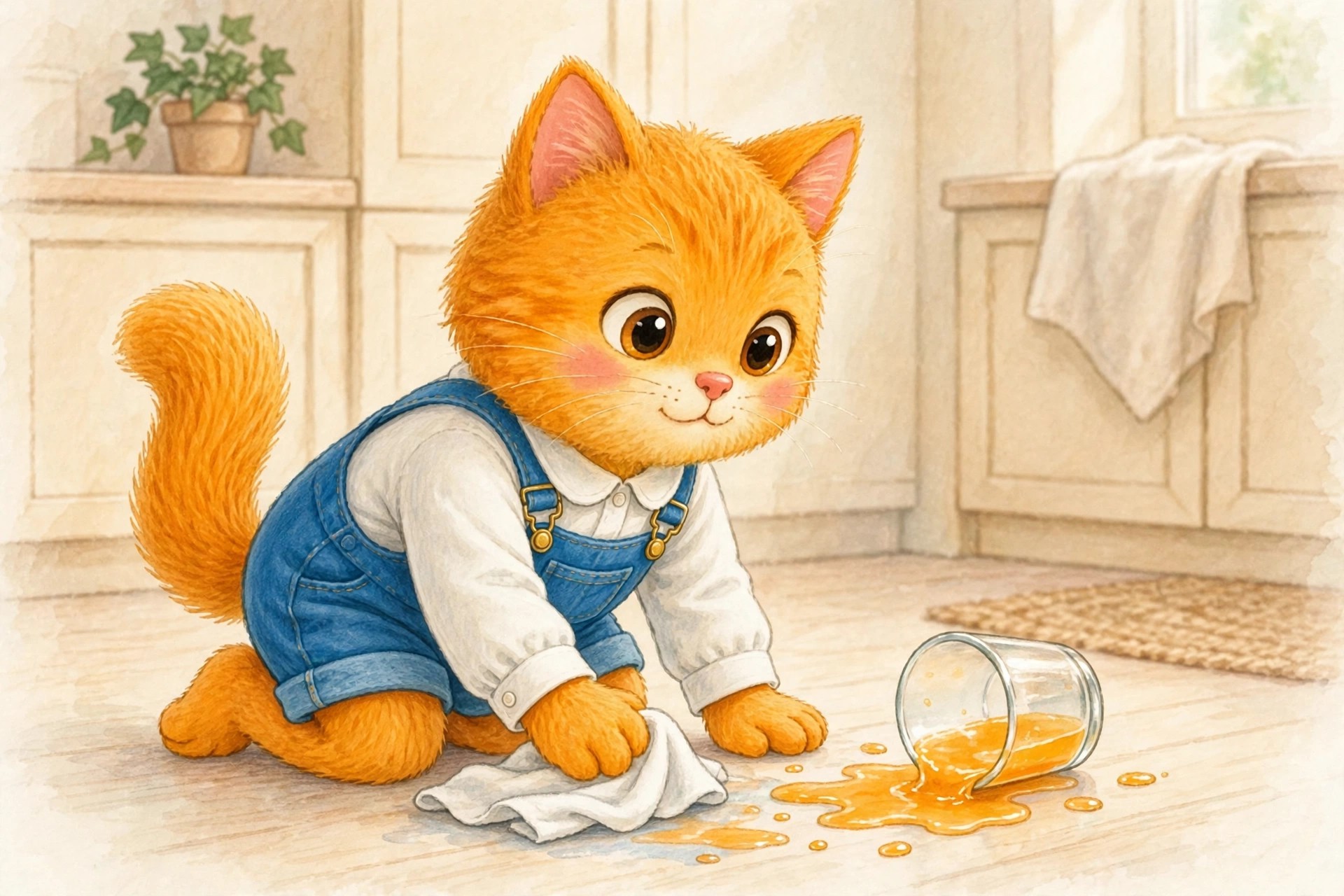
"It wasn't me!"
The juice is on the floor. The cup is in pieces. There is chocolate on a face that has definitely not been near the chocolate. You saw it happen — and the denial is somehow worse than the spill.
The spill was small. What stings is the "not me." It can feel like a crack in the trust between you, and it is tempting to repair that crack with a cross-examination: "Did you do this? Are you sure? Look at me."
Here is the quieter truth: your child is probably not lying about the cup. They are hiding from the reaction they expect next. And once you see the lie as a shield rather than a verdict, the way through it gets much simpler.
Make the truth safer than the lie. Say what you see, thank your child for the truth, fix the mistake together, then stop. A mistake is something to fix, not a test to pass — and a child who is thanked for the truth will bring it to you again next time.
Between three and eight, three patterns are common, and none of them means a dishonest character.
First, they are predicting the reaction. The lie is aimed at the storm, not the spill. If telling the truth has led to shouting, tears, or a long lecture before, "not me" is simply the safest sentence they know.
Second, shame blurs the line between the act and the self. "I did a bad thing" slides quickly into "I am bad," and hiding feels like protection from that verdict. A child who believes the mistake is them will hide the mistake to hide themselves.
Third, young children often say what they wish were true. "I didn't do it" is not always a plan — sometimes it is a wish said out loud, and the words themselves feel like a fix. Wishing is a young brain's first tool; it takes time and practice to trade it for telling.
None of this is a character flaw. It is a small person protecting themselves from a big feeling, with the only tools they have so far.
Asking a question you already know the answer to turns the truth into a test with a trapdoor. Your child is not being asked for information — they are being asked to confess, on the record, and they can hear the verdict waiting on the other side of "yes."
Consequences for honesty teach the same lesson from the other direction. If telling the truth reliably costs more than hiding, children do not become more honest. They become better at hiding — and they get better every year.
Interrogation gives the lie a stage and a second act: "Are you sure? Did you really not do it?" Each round asks your child to defend the story instead of repairing the spill, and the story gets harder to walk back with every repetition.
The alternative is boring, kind, and short: say what you see once, and move to what happens next.
This takes five minutes, and it has four steps.
1. Say what happened, in one calm sentence. "The cup fell and broke." "There's juice on the floor." No courtroom, no cross-examination — just the fact, stated plainly, so there is nothing to argue with.
2. Thank the truth. "Thank you for telling me the truth." This is the step that does the teaching. It separates the mistake from the child: the spill is a problem to solve, and the telling is something to be proud of.
3. Fix it together. Wipe the juice, pick up the pieces (you handle anything sharp), say sorry if someone was hurt. Your child helps with one small part — holding the cloth, fetching the bin. Repair is where responsibility actually grows.
4. Close it. "All fixed." Then lunch, the park, the next thing. No re-litigating at dinner, no "remember what you did this morning?" A closed mistake stays closed, and that closure is what makes the next truth cheaper.
A few phrases carry the whole ritual: "Mistakes are for fixing." "The cup is broken. Cups break." "You are not in trouble for telling me."
Read Honest Mimi together at a calm moment first — before any mistake, not during one. Then model a small mistake of your own out loud: "Oops, I spilled the water. I'll wipe it up." When your child's next small mistake comes, run the ritual: one calm sentence, thank the truth, fix it together, done.
Three common moves feel like teaching but mostly teach hiding:
Interrogating. "Are you sure? Look at me. Did you really…?" teaches that the first answer is never believed — so why offer it?
Punishing the lie harder than the mistake. Double punishment (one for the spill, a bigger one for the lie) feels fair, but it teaches one skill very well: hide better next time.
The "liar" label. Children live up to the names they are given. "You told a lie" describes an action that can change. "You are a liar" describes a person — and a child who believes that about themselves has very little left to protect by telling the truth.
Children rehearse hard conversations through stories they love enough to revisit:
In Honest Mimi, Mimi the cat faces a choice about admitting a mistake, and honesty and the courage to speak are the centre of the story. It is a gentle starting point for talking about what support makes truth-telling easier — and it introduces Mimi, the star of our virtue series (Honesty, Patience, Kindness, Self-Control, Courage, Gratitude, Responsibility and Perseverance). Ages 3–7.
Find it here: Honest Mimi (all book links on this site go through our book pages to Amazon).
Read it before the mistake happens, not in the middle of one. A story read calmly, earlier in the day, gives your child Mimi's words to borrow when their own are hard to find.
Don't argue the fact. Say what you saw, once — "I saw the cup fall" — and move straight to the repair. The lie is a shield, and arguing with a shield only makes your child hold it tighter. Each time the truth costs less than the hiding, the shield comes down a little, and "not me" arrives a little less often.
Yes — but attach it to the repair, not to an extra punishment. The fixing is the consequence that teaches: wiping, mending, saying sorry. A separate, bigger punishment for the lie teaches a different lesson entirely — that the telling, not the spill, is the dangerous part — and the hiding gets better each year.
Keep the two separate, and keep both short. Thank the truth specifically — "Thank you for telling me. That was brave." — then repair the mistake calmly, without a speech. The thanks is for the telling; the fixing is for the spill. Children can hold both ideas at once when we hold them apart for them.
Keep going: For the other half of the same conversation, read "When Little Worries Grow Big: Talking With Your Child About 'What If…?'" — or browse the Storytime Journal for more.
Free to try: Browse our Free Resources page for printables to try at storytime, including worksheets your child can colour and complete.
Stay in the loop: Join the Story Club for one gentle story idea each week.
Ages 3–7 yearsMimi faces a choice about admitting a mistake.
Explore This Story