 Ages 3–8 years
The What-If Monster
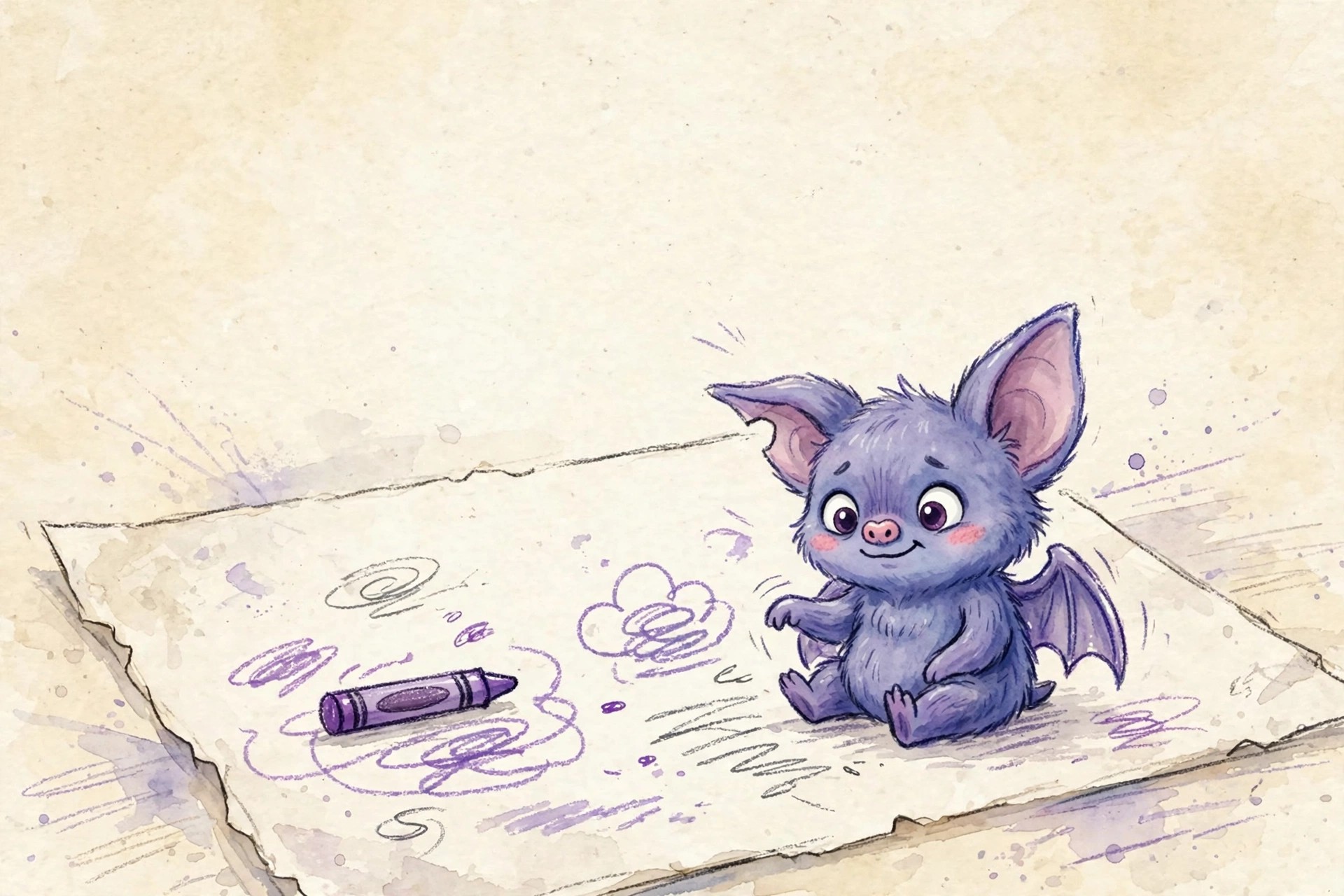
Boba the bat’s imagination turns little worries into a large, clumsy What-If monster.
Explore This Story Join Story Club
Confidence & Self-Acceptance
"What if it rains tomorrow? What if the dog barks? What if nobody plays with me?"
It usually starts at the worst moment — in the car, at the school gate, or just as the lights go out. You answer one question, and another pops up behind it.
The questions are not the problem. They are your child trying to feel ready for a world they cannot control. The worry was never really about the rain or the dog. It was about the feeling underneath — "I'm not sure I'll be okay" — and feelings don't shrink when you argue with them. They shrink when they are named and given a size a child can hold.
Don't argue with the worry — name it and shrink it. Draw the worry together and make it clumsy and a little funny, then ask three questions: What is most likely to happen? If it did happen, what could we do? Who could help us? A worry a child can picture is a worry they can put down.
Between three and eight, imagination grows faster than experience. Children can picture things that have never happened — a storm, a dark room, a first day somewhere new — and the picture feels almost as real as the thing itself.
Three patterns are common, and none means anything is wrong. First, the worry grows each time it is repeated. "What if it rains?" becomes "What if it storms?" Second, the same question comes back even after a good answer. Your child is checking whether the safe feeling is still there. Third, worries cluster at tired times — bedtime, the school gate, the car ride home.
Once you see the pattern, the goal changes: give your child a way to hold the worry, look at it, and set it down.
"Don't worry" is the kindest sentence that doesn't work. First, it tells a child their feeling is wrong. Your child is worried. Being told not to be doesn't remove the feeling — it adds a second one: "I'm worried, and now I'm also wrong for worrying." Second, it asks for the impossible. You cannot switch a feeling off by deciding to. Third, it ends the conversation. "Don't worry" has nowhere to go, so the worry comes back five minutes later, looking for a better listener.
What works instead is the opposite move: take the worry seriously, in a small, playful way. "That sounds like a big worry. Let's look at it together." You are agreeing that the feeling is real — and a real feeling can be worked with.
This takes five minutes and a piece of paper. Ask your child to give the worry a name — not their name, the worry's name. "The What-If Monster" is a good start, or let them invent one: "Sir Wobbles." A named worry is already smaller, because it is a character now, not a cloud over everything.
Then draw it together. The rule: make it clumsy and a little funny. Too many feet, a tiny hat, a wobbly tooth. The point is not good art — it is a change of size. A monster that trips over its own feet cannot be in charge of the evening.
While you draw, ask what the monster says, and write its words in a speech bubble: "What if nobody plays with me?" Seeing the sentence on paper, outside their head, turns it into one sentence among others, on a page they control. Keep the drawing on the fridge. Next time, point at it: "Ah, Sir Wobbles is back."
Once the worry has a name and a picture, ask three questions, slowly, one at a time.
1. "What is most likely to happen?" Not what could happen — what usually happens. It rained last week, and the plan still worked. Naming the ordinary outcome gives the worry a rival.
2. "If it did happen, what could we do?" This turns a worry into a plan. If it rains, we take the umbrella and jump in one puddle. A child with a plan knows the next step, and the next step is usually small.
3. "Who could help us?" Naming a helper — a teacher, a grandparent, you — reminds your child they are not facing the what-if alone. Let them choose. The list is the comfort.
Use the same three questions every time, in the same order. After a few rounds, children start asking them themselves.
When the first "what if" arrives, don't answer it straight away. Say, "Let's ask Sir Wobbles." Draw the worry together, write its question in a speech bubble, then ask the three questions: most likely? what could we do? who could help? Five minutes, one drawing, then the usual bedtime story.
Bedtime is when worries queue up, because the day's distractions are gone. If the what-ifs arrive after lights-out, don't reopen the whole conversation. Try one sentence: "Sir Wobbles is on the fridge. He can wait until morning." Then the familiar landing: the same story, the same slow voice. The routine is the answer at bedtime — not a new explanation, which only wakes the brain back up.
If your child gets up with one more what-if, listen for thirty seconds, repeat the plan in one line — "Umbrella, one puddle, Mum helps" — and walk them back.
And if the worries keep coming, night after night, for weeks, and your child seems tired or unhappy most days, trust your own judgement and talk it over with someone who knows your child — their teacher, your family doctor, or another professional you trust. Noticing early and asking for support is part of good parenting, not a failure of it.
Children learn to handle worries through stories they love enough to revisit:
In The What-If Monster, Boba the bat's imagination turns little worries into a large, clumsy What-If monster. That playful image gives you a way to talk about worrying thoughts without treating your child as the problem. Ages 3–8.
Find it here: The What-If Monster (all book links on this site go through our book pages to Amazon).
Clover's Worry Wobbles is the quieter companion: Clover feels fluttery before speaking to her nursery class, and with her mother's guidance she finds a gentle breathing moment. It is a story about nervousness and accepting support — a good one for the child whose what-ifs arrive before speaking up, not just before bed. Ages 2–6.
Find it here: Clover's Worry Wobbles (all book links on this site go through our book pages to Amazon).
Read either story before the worry arrives, not in the middle of it. A story read calmly, earlier in the day, gives your child the monster's picture to borrow later.
They are not forgetting your answer — they are checking whether the safe feeling is still there. Answer briefly, then hand the question to the routine: point at the drawing, ask the three questions, and stop there. Repeating a long new answer each time teaches your child that the worry needs a fresh argument; repeating the same short routine teaches them that the worry has a familiar ending. If the same question returns for weeks, keep the routine and note when it happens — tired times, new places, separations — so you can prepare the drawing before the moment, not during it.
You almost certainly won't, if you stay with naming and listening rather than arguing or dismissing. The phrases that help are small ones: "That sounds like a big worry." "Let's look at it together." "What is most likely to happen?" If a conversation goes badly, you can repair it in one line the next morning: "Yesterday I said 'don't worry' too quickly. Your worry was real. Shall we draw it today?" Children forgive a clumsy answer far more easily than a feeling that was never heard.
Trust what you see over weeks, not one hard night. If worries are there most days, keep your child from things they used to enjoy, leave them tired or unhappy, or you feel out of your depth, talk it over with someone who knows your child — their teacher, your family doctor, or another professional you trust. You know your child best, and asking for support early is a strong, ordinary part of parenting. This article offers everyday conversation ideas only; it is not medical advice, and it does not replace professional guidance for your child.
Keep going: For more on the other end of the day, read "Don't Touch My Tower!" How to Turn Cleaning Up Toys Into a Game — or browse the Storytime Journal for more. Coming Nov 25: "When Your Child Won't Tell the Truth About a Mistake."
Free to try: Browse our Free Resources page for printables to try at storytime, including worksheets your child can colour and complete.
Stay in the loop: Join the Story Club for one gentle story idea each week.
Ages 3–8 yearsBoba the bat’s imagination turns little worries into a large, clumsy What-If monster.
Explore This Story Ages 2–6 years
Clover feels fluttery before speaking to her nursery class.
Explore This Story